
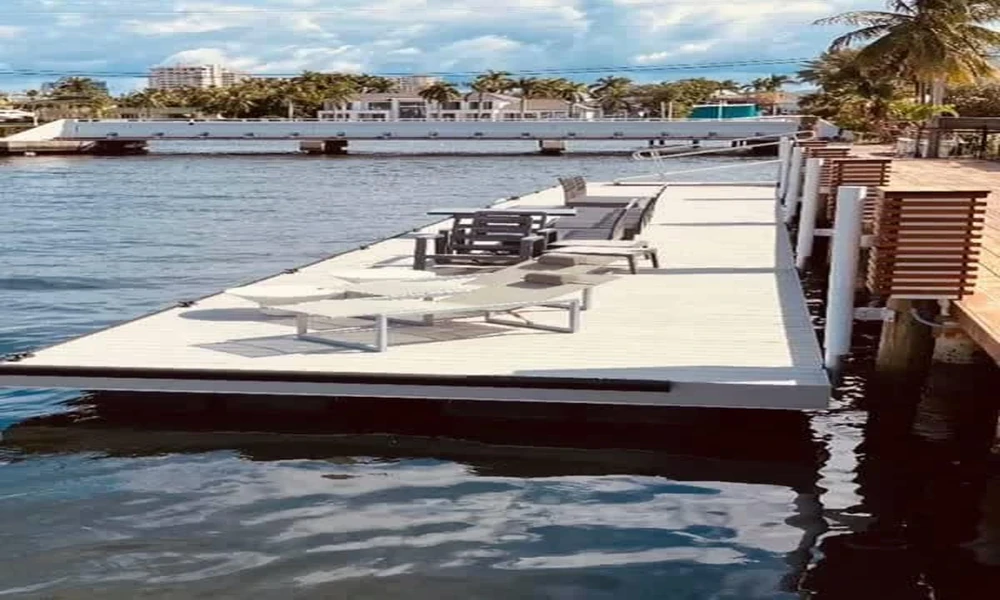
People planning a floating dock often ask, “How many dock floats do I need?” The number comes from a fairly simple weight calculation that compares the total weight on the dock with the weight each float can hold.
The weight on a dock falls into two groups. Dead load is the weight of the dock itself, including the frame, the decking, the cleats and any built-in parts such as benches or dock boxes. Dead load stays the same every day, while live load is the weight that comes and goes. People, coolers, fishing gear, kayaks and carts all count as live load.
Each float has a buoyancy rating, which shows how many pounds the float can hold up while sitting at a set depth in the water. A float that holds more weight is usually larger or deeper.
Designers add the dead load and the planned live load together and divide that total by the rating of one float, and the result is the minimum number of floats. They then add more floats to create reserve buoyancy, which keeps the deck above the water when many people gather in one spot.
Where the floats go matters as much as how many there are. Heavy items such as a gangway landing, a boat lift or a dock box press down on one area, so extra floats go under those spots. A long, narrow walkway needs floats spaced evenly along its length. A wide platform needs floats near each edge so it does not tip.
Deck height also changes the count, because a dock that rides higher above the water needs more flotation under it.
When a dock has too few floats, one corner can drop low as soon as several people stand on it, and a float layout matched to the load prevents that problem.
Supreme Floating Docks in Fort Lauderdale designs floating docks and plans the number and position of the floats around the dock’s load and use.